How does Box 3 apply to vacation rentals?
What about taxes?
Investing in a vacation rental is lucrative: you get to enjoy the property yourself and benefit from both rental income and a potential appreciation in value. But what about taxes?
The Tax and Customs Administration charges a so-called notional return on your assets in Box 3, which also includes vacation rentals provided you do not permanently reside there. This often raises questions: how much tax do you have to pay? What is the impact of a loan? And how does this compare to savings?
On this page, we will explain clearly how Box 3 works, what it means for your vacation rental, and why an investment often proves to be tax-efficient. With clear examples, up-to-date figures, and smart insights on reducing your tax burden.

How does Box 3 work exactly?
We explained it in 5 steps. Check them out below. ⤵︎
1. Calculating value on January 1
1. Calculating value on January 1
The value of your vacation home (usually the WOZ value or market value) is added to the value of other assets, such as:
- Savings
- Stocks/investments
- Other real estate (such as additional residential units)
From this amount, you will subtract any debts (encumbering these assets).
2. Apply exemption
2. Apply exemption
In 2025, every taxpayer will have an exemption of €57,684. Are you a tax partner? In that case, you are jointly entitled to a €115,368 exemption.
3. Calculate your taxable base
3. Calculate your taxable base
Your total assets in Box 3 are determined by the value of your holdings, such as your vacation home, savings, and investments. First, subtract any deductible debts from this amount.
1. Determine your net worth:
Your total assets minus the portion of your debts that exceeds the debt threshold equals your net worth. The debt threshold in 2025 is:
- €3,400 without a tax partner
- €6,800 with a tax partner
2. Apply the exemption to calculate your taxable assets:
Subtract the exemption from these net assets to arrive at your taxable assets. For 2025, the exemption is €57,684 per person (€115,368 with a tax partner).
For example: If you have €350,000 in assets without any debt and a €57,684 exemption, your taxable assets are €292,316.
Example without a partner
- Totale beleggingen: €350.000
- Debt: €100,000
- Debt Threshold: €3,400
- Deductible debt: €100,000 – €3,400 = €96,600
- Net worth: €350,000 – €96,600 = €253,400
- Exemption for 2025: €57,684
- Taxable base: €253,400 – €57,684 = €195,716
You pay tax on €195,716, not on the full €350,000, thanks to the deductible debt and exemption.
4. Calculating the notional return
4. Calculating the notional return
The Tax Authority expects you to earn a certain rate of return on your assets, depending on how your assets are distributed across:
-
Savings (1.44% notional return)
- Example: You have €350,000 in savings
- Exemption in 2025: €57,684
- Taxable capital: €292,316
- Notional return: 1.44% of €292,316 = €4,209
- Tax due: 36% of €4,209 = €1,515
So you pay €1,515 in taxes on your savings in Box 3, even if you simply have that money sitting in a savings account and may have earned hardly any interest on it.
-
Investing (5.88% notional return)
- Example: You have €350,000 in investments (e.g. vacation home, stocks, cryptocurrency)
- Exemption in 2025: €57,684
- Taxable capital: €292,316
- Notional return: 5.88% of €292,316 = €17,184
- Tax due: 36% of €17,184 = €6,186
In this case, you will pay €6,186 in taxes in Box 3
-
Debt (–2.62%)
Example: €250,000 in investments + €100,000 in debt (Box 3 – 2025)
Step 1: Assets and exemptions
- Investments: €250,000
- Debt: €100,000
- Exemption: €57,684
- Debt threshold: €3,400 (2025, without a partner)
- Deductible debt: €100,000 – €3,400 = €96,600
- Net worth: €250,000 – €96,600 = €153,400
- Taxable capital: €153,400 – €57,684 = €95,716
Step 2: Calculate the notional return (estimated)
- Investments: €250,000 → 5.88% = €14,700
- Debt: €96,600 → –2.62% = –€2,531
- Total notional return = €14,700 – €2,531 = €12,169
Step 3: Tax due
-
36% of €12,169 = €4,381
Conclusion
With a vacation home worth €250,000 and €100,000 in debt, you will pay approximately €4,381 in capital gains tax in Box 3 in 2025.
Without the debt, this would be well over €5,000—so you save about €600 in taxes because of the debt.
5. Tax calculation (36% in 2025)
5. Tax calculation (36% in 2025)
You will pay 36% tax on the calculated notional return.
The tax on my savings in Box 3 is much lower—so is it really a good idea to invest in a vacation home?
Why investing in a vacation home can be a good idea—even with Box 3 tax and debt
It's true: the tax on savings in Box 3 will be relatively low in 2025, with a notional return of 1.44%. But the question is: what do your savings get you? It's often less than inflation. A vacation home, on the other hand, generates steady rental income (which is not taxed under Box 3), may appreciate in value over the long term, and offers the opportunity to use it yourself for vacations.
In addition, a vacation home can be financed with a loan (a Box 3 debt). This debt reduces your taxable net worth, which can significantly lower your tax burden. So you're converting your capital into a tangible asset, rather than letting it lose value due to inflation.
Managing your assets wisely
By converting (part of) your savings into a vacation home, you’re shifting from low-yield savings to an asset with the potential for a much higher return. With the right financing, you can also use debt as leverage, while your taxable assets decrease due to the debt you can deduct in Box 3.
Less taxes, more potential
Instead of a 1.44% notional return on your savings, you may have to pay taxes on a 5.88% return on your home. But the actual return on a vacation home is often much higher than the interest on your savings, and because you finance part of the purchase with debt, you often end up paying proportionally less in taxes than you might expect.
If you'd like to create a sample for your specific situation, please feel free to contact us!
Four scenarios outlined for Box 3
Scenario 1 – €150,000 with tax partner
Scenario 1 – €150,000 with tax partner
Situation:
- Investments: Vacation rental with a WOZ value of €150,000 (e.g. vacation rental or investment portfolio)
- Exemption with tax partner: €115,368
- No debt
Calculation:
- Taxable assets: Vacation rental with a WOZ value of €150,000 – €115,368 = €34,632
- Notional return (5.88% on WOZ value): €2,036
- Tax (36% on notional return): €733
Difference compared to 2024:
- In 2024, the exemption was lower (€114,000). You would have paid approximately €783 at that time.
- Difference: – €50
Scenario 2 – €150,000 without a partner
Scenario 2 – €150,000 without a partner
Situation:
- Investments: Vacation rental with a WOZ value of €150,000
- Exemption: €57,684
- No debt
Calculation:
- Taxable assets: Vacation rental with a WOZ value of €150,000 – €57,684 = €92,316
- Notional return (5.88% on the WOZ value of the vacation rental): €5,428
- Tax (36%): €1,954
Difference compared to 2024:
- In 2024, you would have paid approximately €2,022 on this amount.
- Difference: – €68
Scenario 3 – €350,000 without debt or a partner
Scenario 3 – €350,000 without debt or a partner
Situation:
- Investments: €350,000
- Exemption: €57,684
- No debt
Calculation:
- Taxable assets: €350,000 – €57,684 = €292,316
- Notional return (5.88%): $17,184
- Tax (36%): €6,186
Difference compared to 2024:
- In 2024, you would have paid approximately €6.267 here.
- Difference: – €81
Scenario 4 – €350,000 in investments + €100,000 in debt, without a partner
Scenario 4 – €350,000 in investments + €100,000 in debt, without a partner
Situation:
- Investments: €350,000
- Debt: €100,000
- Debt threshold: €3,400 → Deductible debt: €96,600
- Exemption: €57,684
Calculation:
- Net assets = €350,000 – €96,600 = €253,400
- Taxable assets = €253,400 – €57,684 = €195,716
- Notional returns:
- 5.88% on €195,716 (taxable assets) = €11,503.50
- This notional return is calculated on the total taxable assets, which mainly consist of investments.
- Tax (36%): €4,141.26
Difference compared to 2024:
- In 2024, you would have paid approximately €3,576 here.
- Difference: +€566
Read more about investing and returns



Would you like to find out more?
Fill in the form below and download all the information about our projects straight away.

Would you like us to get in touch with you?
Do you need more information or do you have any questions? Our team is here to assist you.
Contact usWhat to expect
- Learn about our mission and vision
- Take a look at the projected returns
- Take a look at the options
- Exclusive models of the homes
- Get to know the organization
 Visit our resorts
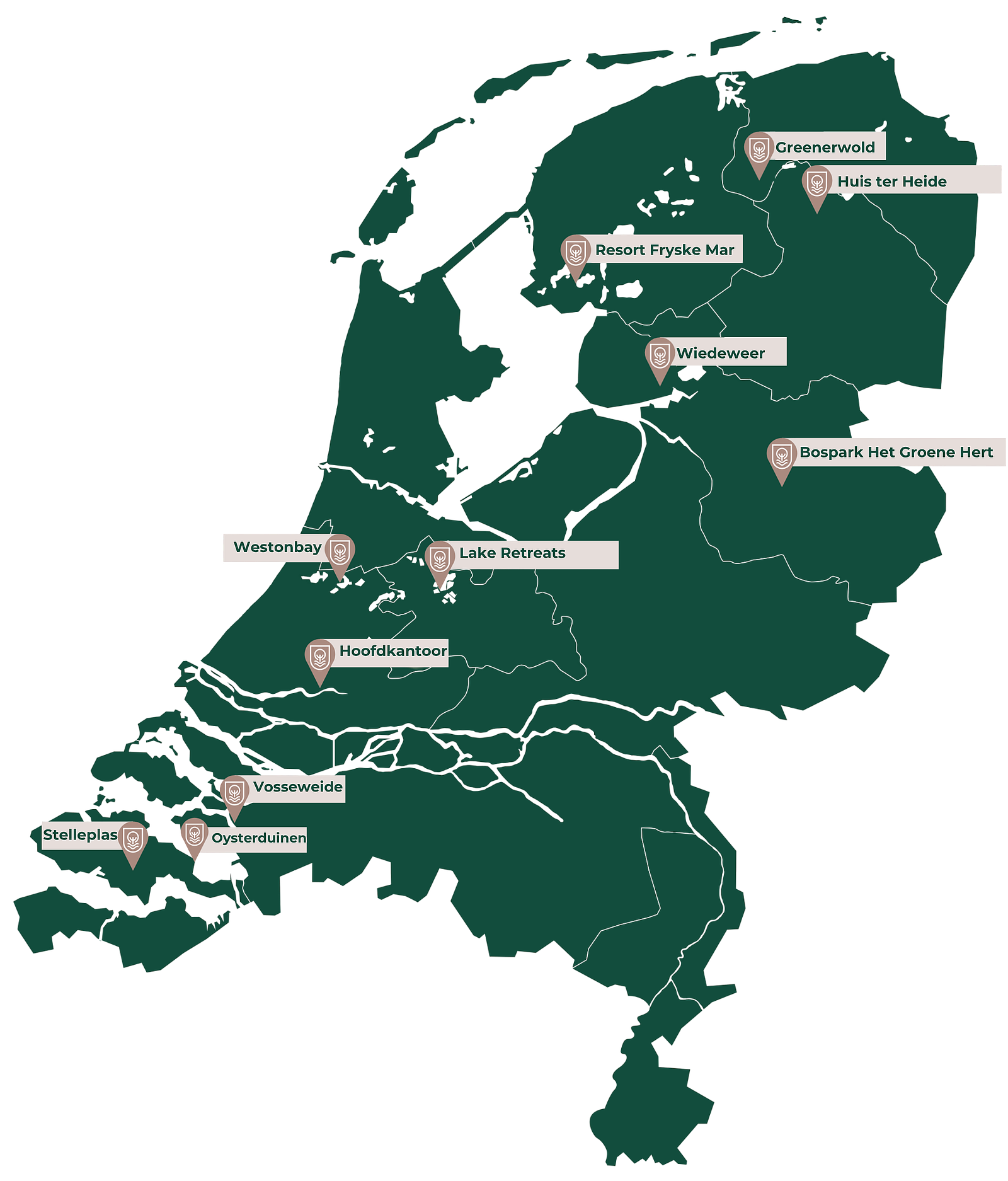
Resort Fryske Mar
Tjamskedykje 6, 8561 HA Balk,
Friesland
Wiedeweer
Kraggenburgerweg 2-A, 8317 RG Kraggenburg
Resort Westonbay
Grote Poellaan 101, 1435 GE Rijsenhout
Greenerwold
Roordaweg 3A, 9365 PN Niebert, Groningen
Huis ter Heide
Zuiderstraat 6P, 9491 TH Zeijen,
Drenthe
Landgoed De Huynen
Westdorperstraat 37, 9443 TM Schoonloo, Drenthe